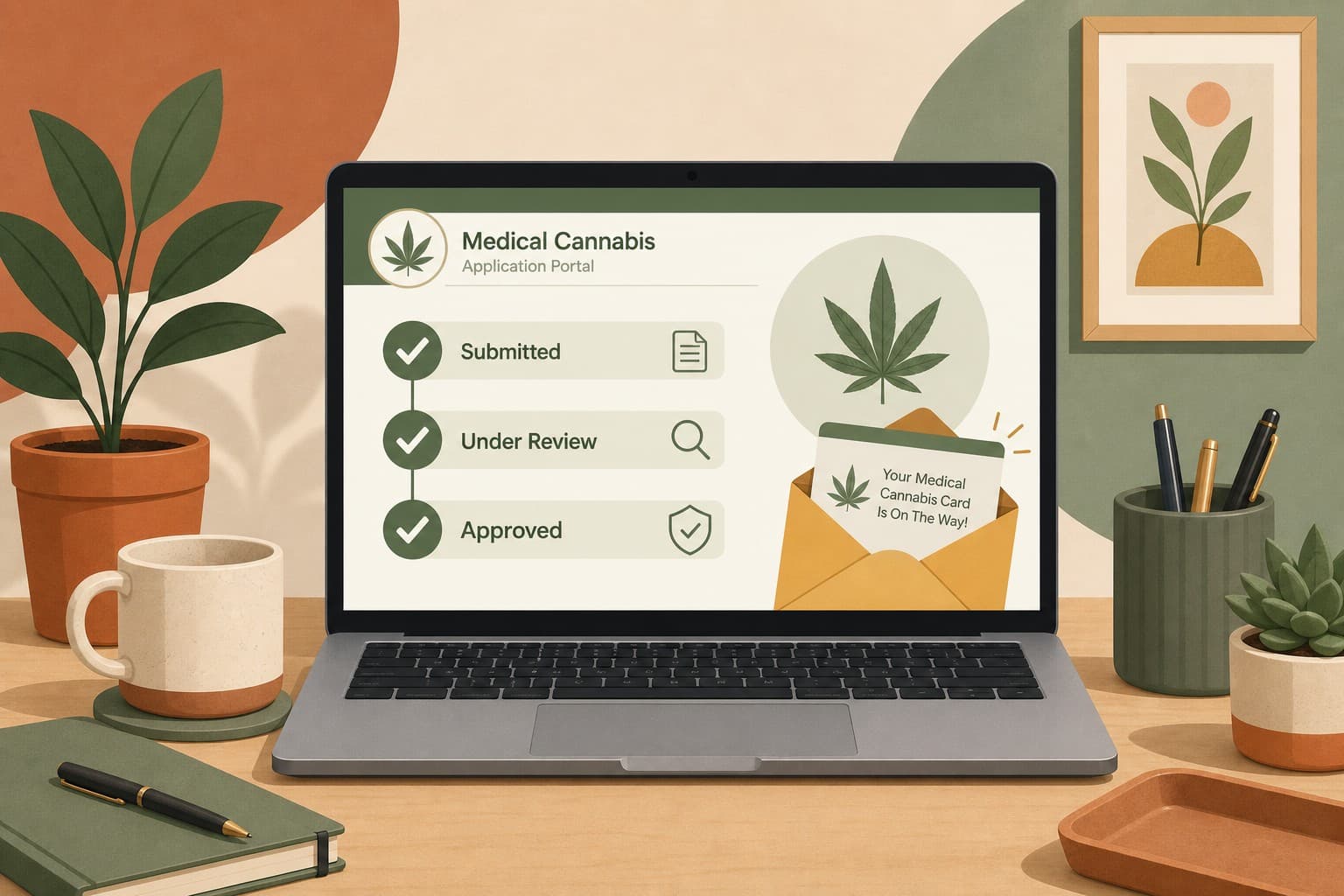
You did the hard part. You got your physician certification, gathered your documents, and hit submit on your Oklahoma medical marijuana application. Now comes the part nobody warns you about: the waiting.
If you're refreshing your email every hour wondering where your application stands, you're not alone. The good news is that the Oklahoma Medical Marijuana Authority (OMMA) gives you a way to check your application status yourself, at any time, in about a minute. This guide walks you through exactly how to do it, what each status actually means, how long approval normally takes, and what to do if things seem stuck.
Quick Answer: Where to Check Your OMMA Application Status
You check your OMMA application status by logging into the same online licensing portal you used to apply — the OMMA MedPortal at medportal.omma.ok.gov. Once you're signed in, click the "Applications" tab to see every application you've submitted and its current status.
OMMA also sends email updates when your status changes, so keep an eye on the inbox (and spam folder) of the email address you applied with.
How to Check Your OMMA Application Status, Step by Step
If you haven't logged back in since you applied, here's the full walkthrough:
- Go to the OMMA MedPortal. Open medportal.omma.ok.gov in your browser. This is the official state licensing portal — be cautious of lookalike sites that charge a fee to "check" your status for you.
- Sign in. Use the same email address and password you created when you applied. If you've forgotten your password, use the "Forgot your password?" link to reset it.
- Open the Applications tab. Once you're in your account dashboard, click "Applications." You'll see a list of everything you've submitted.
- Find your current application. If you've applied more than once (say, an original application and a renewal), check the submission dates to make sure you're looking at the right one.
- Read the status. Your application's current status appears right in the list. The next section explains what each one means.
That's it. You don't need to call anyone or pay anyone — checking your status is free and takes under a minute once you're logged in.
What Each OMMA Application Status Means
The wording in the portal can be a little cryptic. Here's a plain-English translation of the statuses applicants see most often:
- Submitted / Received — OMMA has your application and it's in the queue. Nothing is wrong; it simply hasn't been reviewed yet. Most applications sit here for the majority of the waiting period.
- Under Review — A reviewer is actively looking at your application and documents. This is a good sign.
- Additional Information Requested (or similar wording) — Something in your application needs fixing or clarifying — often a blurry photo, an expired ID, or a signature date issue. OMMA will email you about what's needed. Respond promptly, because your 14-business-day clock can effectively pause until you do.
- Approved — Congratulations. Your patient license has been approved, and your physical card will be printed and mailed to the address on your application.
- Rejected / Denied — OMMA found a problem that couldn't be resolved. This isn't necessarily the end of the road — see the rejection section below.
If your status hasn't changed in days, don't panic. Statuses often jump straight from "Submitted" to "Approved" without much in between.
How Long Does OMMA Take to Approve an Application?
OMMA's stated processing time for patient license applications is 14 business days — that's business days, not calendar days, so weekends and state holidays don't count. In practice, 14 business days works out to roughly three weeks of real time.
A few things worth knowing about the timeline:
- Some approvals come faster. Plenty of applicants report getting approved in under two weeks, especially when their paperwork is clean and complete.
- The clock starts when your application is complete. If OMMA requests more information and you take a week to respond, that week is on you, not them.
- Mailing takes extra time. After approval, your physical card is printed and mailed, which can add several more days before it's in your mailbox.
If you're earlier in the process and still gathering what you need, our Oklahoma medical card requirements checklist covers every document OMMA accepts so you can submit a clean application the first time.
What to Do If Your Application Is Taking Longer Than 14 Business Days
First, double-check the math: count only business days since you submitted (or since you last responded to an information request). If you're genuinely past 14 business days, here's the sensible order of operations:
- Log into the MedPortal again. Look carefully for any "additional information requested" flag you might have missed, and check your email spam folder for messages from OMMA.
- Verify your contact details. A surprising number of delays come down to a typo'd email address or an old mailing address on the application.
- Contact OMMA directly. You can reach the Oklahoma Medical Marijuana Authority through the contact options listed on oklahoma.gov/omma. Have your application reference details and the email you applied with ready.
- Don't submit a duplicate application. A second application won't speed anything up and can create confusion in the system. Work the one you have.
Common Reasons OMMA Applications Get Rejected (and How to Fix Them)
Most rejections trace back to a handful of fixable problems:
- Photo issues. The photo must meet OMMA's rules — recent, clear, plain background, no hats or sunglasses. A selfie taken in poor lighting is the classic rejection trigger.
- Expired or unclear ID. Your proof of identity and Oklahoma residency documents need to be current and legible.
- Physician certification problems. The certification form must be filled out completely, signed, and dated within the required window. An outdated or incomplete form is a common reason applications bounce.
- Signature date mismatches. Dates on different parts of the application need to line up.
If your application is rejected, OMMA's notice will tell you why. In most cases you can correct the problem and reapply. The fee situation on reapplication depends on the circumstances, so check OMMA's current guidance rather than assuming.
Haven't Applied Yet? Start With Your Physician Certification
If you landed on this page while still researching the process, here's the short version: before you can submit anything to OMMA, you need a written certification from an Oklahoma-licensed physician. That's the step our service handles — a licensed doctor evaluates you (via telehealth, from home), and if you're eligible, you receive the certification you need for your application. From there, you submit to OMMA, and everything in this guide applies to you.
If you'd like the full picture first, our step-by-step guide to getting a medical card in Oklahoma walks through the whole process from evaluation to card in hand, and our plain-English guide to 420 evaluations explains exactly what happens during the doctor visit itself.
The Bottom Line
Checking your OMMA application status is simple: log into the MedPortal at medportal.omma.ok.gov, open the Applications tab, and read the status next to your submission. Patient license applications are processed within 14 business days, and most delays come down to a missed information request or a fixable document issue. Check the portal before you worry, respond quickly if OMMA asks for anything, and your card should be on its way before you know it.